
Custom software development is the process of designing, building, and deploying software built exclusively around one organization's workflows, data requirements, and business goals rather than adapting to a generic commercial product. Unlike off-the-shelf tools such as pre-packaged CRM or accounting platforms, a custom solution fits your processes precisely from day one. For entrepreneurs and small business owners, this distinction matters enormously. You stop bending your operations to match software limitations and start owning a tool that works exactly the way your business does. Custom application development covers everything from internal workflow automation and ERP systems to customer portals and data dashboards built specifically for your team.
What is custom software development and how does it work?
Custom software development is defined as the full lifecycle of creating a software product tailored to a specific organization, including discovery, design, development, testing, deployment, and ongoing maintenance. Each phase serves a distinct purpose, and skipping any one of them increases your risk of building the wrong product.
The process typically follows these phases:
- Discovery: Define requirements, map existing workflows, identify constraints, and align the project scope before writing a single line of code.
- UX/UI design: Create wireframes and prototypes that reflect how your team will actually use the system.
- Development: Engineers build the product in sprints using methodologies like Agile or the Software Development Life Cycle (SDLC), delivering working features incrementally.
- Testing: Quality assurance teams run functional, performance, and security tests to catch issues before launch.
- Deployment: The software goes live using staged rollouts and monitoring to minimize disruption.
- Maintenance: Ongoing support handles security patches, bug fixes, and feature iterations as your business evolves.
Timeline depends heavily on complexity. Simple MVPs typically take 1 to 3 months, medium-complexity projects run 3 to 8 months, and enterprise-grade systems can require 8 to 18 months or more. That range is wide, but it reflects real differences in integration depth, user count, and compliance requirements.
Pro Tip: The discovery phase is the single highest-leverage investment in any custom project. Rushing or skipping discovery is the most common cause of building the wrong product and blowing the budget. Spend real time here, even if it feels slow.

Planning for integration with your existing systems, whether that is a payment processor, a logistics platform, or a legacy database, belongs in discovery too. Software that cannot talk to your current stack creates new problems rather than solving old ones.
How does custom software compare with off-the-shelf solutions?
The build-versus-buy decision is one of the most consequential choices you will make as a business owner. Both paths have genuine merit, and the right answer depends on your specific situation rather than a blanket preference.
Off-the-shelf SaaS tools can be deployed in days to weeks. They carry lower upfront costs and come with vendor support, documentation, and regular updates. For businesses with standard workflows and modest scale, they are often the right starting point. The trade-off is that vendor-controlled products limit your control over features, data architecture, and future modifications. You are renting capability, not owning it.
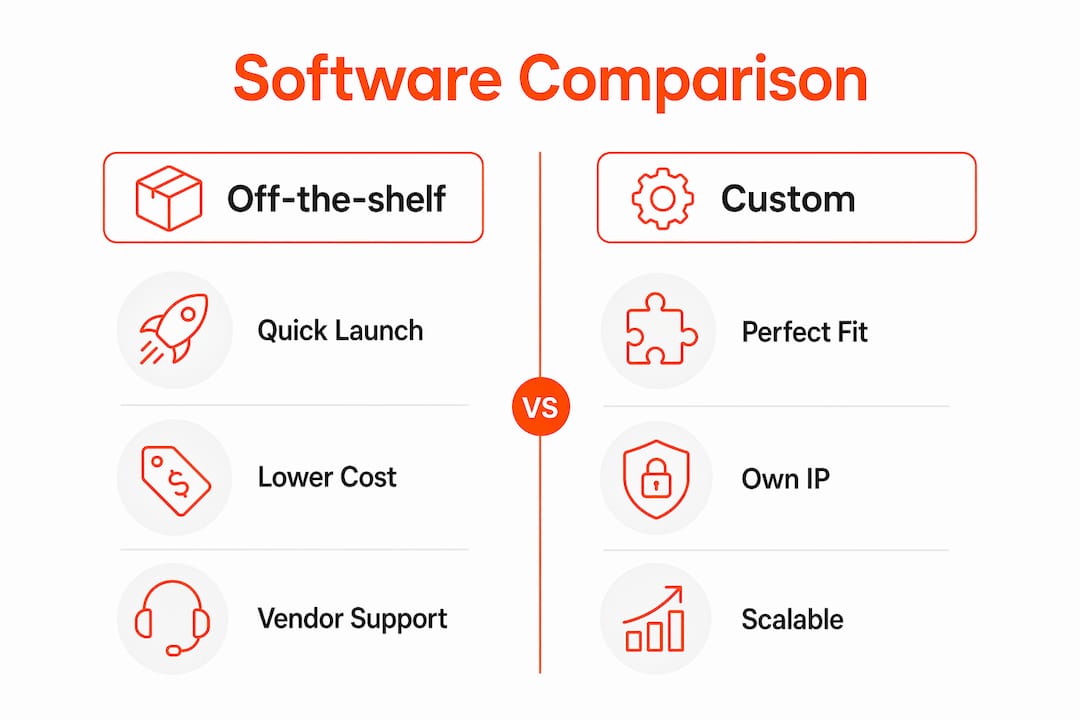
Custom software gives you a perfect fit, full intellectual property ownership, and the ability to scale on your own terms. The five-factor decision framework evaluates build-versus-buy across competitive differentiation, workflow complexity, integration requirements, scale economics, and compliance or data control. Score each factor for your business and the right path becomes clearer.
| Factor | Off-the-shelf | Custom software |
|---|---|---|
| Time to launch | Days to weeks | 1 to 18+ months |
| Upfront cost | Low | Higher initial investment |
| Workflow fit | Generic, requires adaptation | Built to your exact process |
| Ownership | Vendor-controlled | You own the codebase |
| Scalability | Limited by vendor roadmap | Scales on your schedule |
| Data control | Shared or vendor-hosted | Full control |
For smart software options at the small business level, the practical answer is often hybrid: start with off-the-shelf tools to validate your model, then invest in custom development once the limitations become costly enough to justify the build.
What do custom software development costs and maintenance look like?
Cost is where many entrepreneurs underestimate the full picture. The initial build is only part of the investment. Maintenance budgets for custom software typically run 15 to 25 percent of the initial development cost annually. That figure covers security patches, performance improvements, bug fixes, and iterative feature work. It is not optional. Software that goes unmaintained becomes a security liability and a performance drag within 12 to 24 months.
Here is how the cost structure breaks down across the lifecycle:
- Initial build: Ranges from tens of thousands for a focused MVP to hundreds of thousands for enterprise systems, depending on complexity and team location.
- Annual maintenance: Budget 15 to 25 percent of build cost per year for ongoing support and iteration.
- Integration costs: Connecting to third-party APIs, payment systems, or legacy databases adds scope and cost that must be planned upfront.
- Scaling costs: Adding users, data capacity, or new modules requires architectural foresight from the start.
The financial case for custom software versus SaaS subscriptions becomes compelling over a multi-year horizon. Custom software shifts costs from recurring per-user subscription fees to a one-time build plus maintenance model, with breakeven typically occurring in years 2 to 4 depending on user count and SaaS pricing. For a growing team paying $50 to $200 per user per month on multiple SaaS tools, that math can shift quickly in favor of ownership.
Pro Tip: Before launch, build a hypercare plan. Staged rollouts using canary releases, where you route 5 to 10 percent of traffic to the new system first, combined with monitoring dashboards and a documented rollback strategy, dramatically reduce downtime risk during go-live.
How can entrepreneurs use custom software to scale efficiently?
Custom software's core operational advantage is that it aligns perfectly with your workflows rather than forcing your team to work around generic features. That alignment reduces manual tasks, eliminates duplicate data entry, and cuts the workarounds that quietly drain hours from your week.
For small business owners, the practical gains show up across several areas:
- Automation: Repetitive tasks like invoice generation, order processing, or report creation can be automated inside a custom system, freeing your team for higher-value work.
- Integration: A custom platform connects your CRM, finance tools, operations data, and analytics into a single source of truth instead of requiring manual exports between disconnected apps.
- Scalability: Custom software is built to scale, adapting to increases in users, data volume, and new feature requirements as your business grows. Without sound architecture from the start, growth can make a fragile system worse rather than better.
- Competitive advantage: When your software reflects your unique process, competitors using generic tools cannot replicate your operational efficiency simply by buying the same subscription.
Consider a logistics company managing 50 drivers with a spreadsheet and three disconnected SaaS tools. A custom dispatch and tracking platform that integrates scheduling, GPS data, and customer notifications into one interface does not just save time. It changes what the business can offer customers. That kind of differentiation is what software development trends consistently point toward as the defining advantage for businesses that invest in ownership over renting.
If you are evaluating whether to build your own SaaS product rather than buy one, the guide to starting a fundable SaaS business covers the financial and technical considerations worth understanding before you commit.
Key takeaways
Custom software development delivers the greatest return when you own the codebase, plan for maintenance from day one, and build around your actual workflows rather than adapting to vendor constraints.
| Point | Details |
|---|---|
| Definition and ownership | Custom software is built for one organization and gives you full IP and data control. |
| Process phases matter | Discovery, design, development, testing, deployment, and maintenance each reduce risk when done properly. |
| Cost breakeven timeline | Custom software typically breaks even against SaaS costs in years 2 to 4 based on user count and pricing. |
| Maintenance is non-negotiable | Budget 15 to 25 percent of build cost annually for security, performance, and feature work. |
| Scalability requires architecture | Sound system design from the start prevents fragility as users, data, and features grow. |
Why the build-versus-buy decision deserves more time than most owners give it
Most entrepreneurs I have worked with arrive at the custom software conversation after hitting a wall with off-the-shelf tools. They have stitched together four or five SaaS subscriptions, they are paying per-user fees that compound monthly, and their team is manually moving data between systems that do not talk to each other. By that point, the case for custom development is obvious. What is less obvious is that the decision could have been made earlier, with less pain, if they had evaluated it using a structured framework rather than waiting for the frustration to peak.
The uncomfortable truth about custom software is that it is never finished. Maintenance and evolution are integral parts of the product lifecycle, not an afterthought. Owners who treat the launch as the finish line consistently underinvest in maintenance and end up with software that degrades in performance and security within two years. The businesses that get the most from custom development are the ones that budget for continuous improvement from the start and treat their software as a living product.
My honest advice: do not build custom software to save money in year one. Build it because you need control, because your workflows are genuinely complex, or because the competitive advantage of owning your tooling outweighs the upfront cost. If those conditions are not met yet, a well-chosen off-the-shelf solution is the smarter move. When the limits become costly, you will know it is time.
How GemPixel helps you build and own your software
If you have decided that owning your software is the right move, the next question is who builds it with you. GemPixel has delivered custom web development, hosting, and SaaS services to over 12,000 clients, with a model built around one-time investment rather than recurring subscription fees. You pay once and own the platform outright, which means no monthly licensing surprises and no vendor lock-in as you grow.
GemPixel's approach covers the full development lifecycle, from discovery and design through deployment and ongoing support. If you want to see what that looks like in practice, the client projects and case studies page shows real examples of custom platforms built for businesses at different stages of growth. Whether you are replacing a patchwork of SaaS tools or building a new platform from scratch, GemPixelprovides the technical depth and business context to get it right.
FAQ
What is the difference between custom and off-the-shelf software?
Custom software is built specifically for one organization's workflows and owned outright, while off-the-shelf software is a pre-built commercial product designed for a broad market. Off-the-shelf deploys faster at lower upfront cost; custom software provides better long-term fit, scalability, and data control.
How long does custom software development take?
Simple MVPs typically take 1 to 3 months, medium-complexity projects run 3 to 8 months, and enterprise systems can require 8 to 18 months or more depending on scope and integration requirements.
What does custom software development cost to maintain?
Annual maintenance budgets for custom software typically run 15 to 25 percent of the initial build cost, covering security patches, bug fixes, performance work, and iterative feature improvements.
When does custom software become more cost-effective than SaaS?
Custom software typically breaks even against recurring SaaS subscription fees within 2 to 4 years, depending on user count, per-user SaaS pricing, and integration complexity.
What is bespoke software?
Bespoke software is another term for custom software, referring to any application designed and built exclusively for a single organization rather than sold as a general-purpose commercial product. The terms are interchangeable in practice.